
I’ve been collecting screenshots of ads that feel impressive and intelligible until I stop to think about them for 5 seconds. Some of it looks expensive. Some come wrapped in the familiar visual language of expertise: diagrams, quotations, systems, numbered steps. Almost all have the same problem. They appear as one idea among dozens that were generated on a request to “come up with an ad for my business” and then posted in totality without a moment’s review.
This is not an uncommon phenomenon. New Andromeda-style algorithms actually incentivise it, but I’ll give that dead horse a break for a change.
The phrase that best captures the habit is “it’s not X, it’s Y.” If you’ve used AI, you’ve seen it. It’s one of many quirks of AI writing where the machines default to what maybe once was a clever turn of phrase, but has now become incredibly cliché.
I am calling this a habit rather than a linguistic crime because there is nothing inherently wrong with many of these phrases. Sometimes two things really are different, and explaining that difference is useful. The trouble starts when the meaning being conveyed doesn’t actually map onto the real phenomenon being described. X and Y might overlap. One might be a necessary part of the other. But the rhythm is just satisfying enough that nobody asks the next question:
What exact idea are we conveying?
This is why copywriters have a love/hate relationship with LLMs. They’re great for spitballing, but ask one to sharpen a headline or make an idea more provocative, and it can give you a sentence that gives the immediate impression of a complete thought, but only that: the impression of thought. If you copy and paste that sentence straight into your marketing, you are accepting not only what the words say on the surface, but what someone who actually engages with the idea might interpret from it.
The examples below are from a collection I saved while scrolling recently. As a disclaimer, I don’t know how their creators made them, and a familiar phrase or a suspicious-looking graphic is not proof of AI authorship. Humans have been writing confusing marketing organically for a very long time – I kid you not, I once saw an RV with the slogan, “Life is an adventure, take yours!” printed on the side.
What I’m interested in here is the failure modes these examples illustrate: that which occurs when AI-generated work is allowed to go out without a critical second pass.
Your funnel is upside down, dummy!
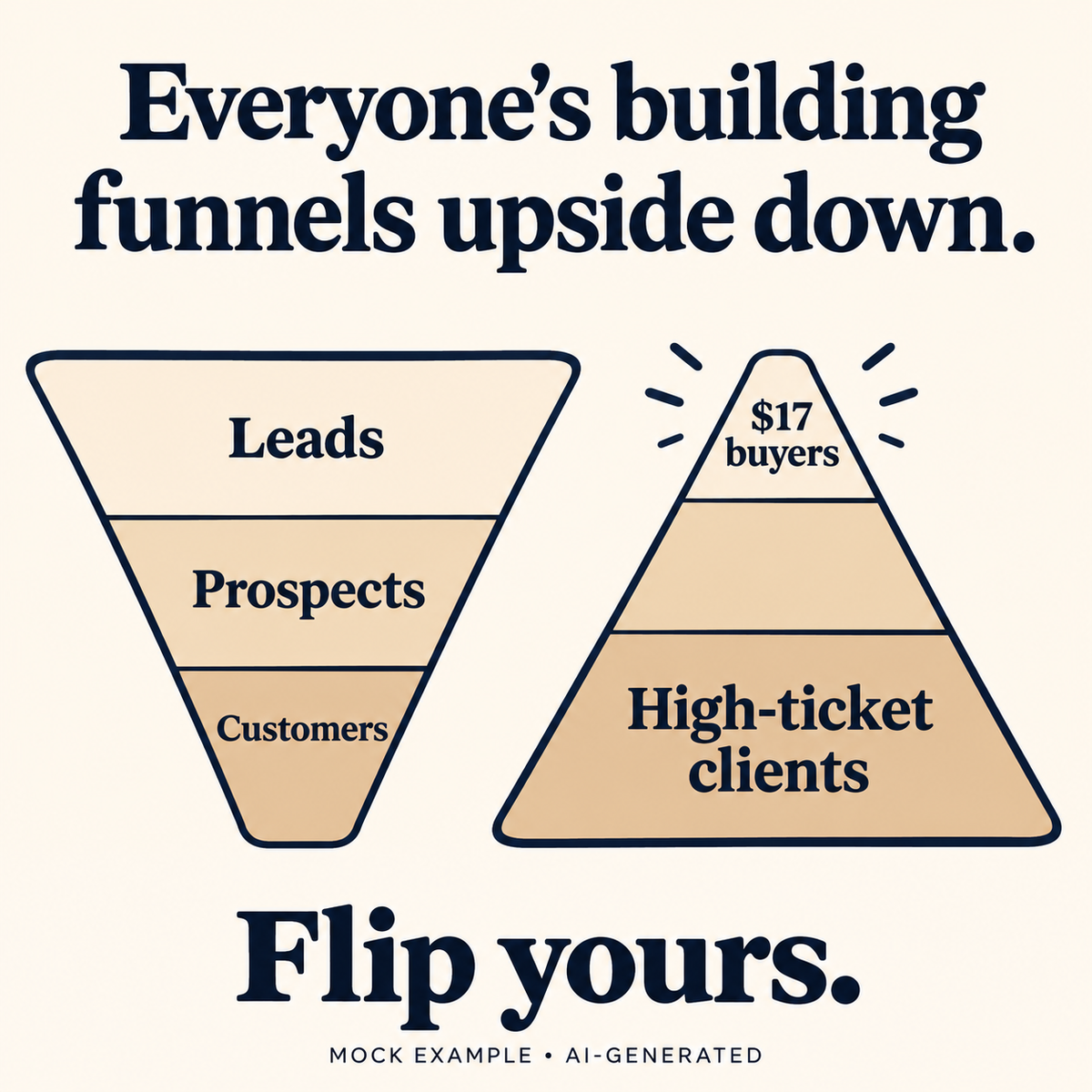
This is the example that most clearly explains what I mean and the one that sparked this article. On the left, a conventional funnel moves from leads to prospects to customers. On the right, the funnel has been inverted, with “$17 buyers” at its narrow end and “high-ticket clients” across its broad base. The headline says, “Everyone’s building funnels upside down.” The instruction underneath is to flip yours.
I can work out the likely sales argument; the idea that was likely meant to be conveyed here.
“Your targeting is too broad. Identify your highest value leads and target them exclusively so you don’t waste time on unqualified leads and raise the average return on your sales.”
You’re saying I should only sell to people who give me more money? Why didn’t I think of that??
While a tad obvious, that is a strategy we can discuss. We could look at the quality of buyers, the economics of acquiring them, and whether the inexpensive offer actually prepares them for the larger one. Then data collection and ad targeting systems can be built to optimize ad spending.
But none of that requires a funnel to be upside down. In fact, the idea of an “upside-down funnel” betrays the fact that a person has never used an actual funnel in their life.
The conventional funnel narrows because, within the group you are seeking, some people drop out at each stage. If you begin with a group of buyers and a subset becomes high-ticket clients, the number of people still narrows. Choosing a more qualified starting group gives you a different funnel. It doesn’t reverse the meaning of the shape.
You could maybe say the widening shape is meant to represent increasing revenue or customer value. Fine, but then just say that, label it, and explain that the diagram is measuring something different. You cannot silently change what the width represents halfway through an argument and expect the metaphor to remain useful.
My objection is to the relationship between the headline, the picture, and the claim. “Flip your funnel” sounds clever, but a couple seconds of thought reveals a fundamental mistake in how marketing works.
A much clearer starting point would be to explain how a low-priced offer can qualify potential customers for a more expensive one. You could still make that interesting. You would just have to do the harder work of explaining the strategy instead of turning the drawing over.
Every good story has a villain

“Anti” has become a quasi strategy in and of itself lately. Just take whatever you’re doing and say that you’re actually doing the opposite somehow. I’m not doing branding! I’m actually doing the opposite!
Not to quibble too much here, but choosing an adversarial position for a brand is still branding. You’re still deciding what the brand stands for, what it opposes, and how people should perceive it. Calling that anti-branding makes the approach sound like an escape from the category while it continues to operate very much inside the category.
If I need my car fixed, why on earth would I seek out an anti-mechanic? I’m the one who busted up my car. If anything, I’m the anti-mechanic.
Also, importantly, what is a business owner supposed to do with the “villain” instruction here? Find a competitor and make them the enemy? Adopt a darker personality? Frame every customer story as a battle? The image leaves that open, but its language and styling invite an adversarial reading.
There are businesses for which an explicitly oppositional position makes sense, sure. There are also perfectly reasonable ways to tell a story about overcoming an obstacle without demonizing another company. The “villain” could be an inconvenient process or a problem the customer faces. If that is the intended meaning here, explain it. The reader should not have to supply the distinction that makes the advice sensible.
My concern is that a business owner might take away a more combative strategy than their situation calls for. You can explain why your service suits a customer better than the alternative without turning the alternative into a moral enemy. The value of that distinction gets lost when the phrase is treated as self-explanatory wisdom.
Again, the phrasing here sounds provocative. The strategy underneath it still needs to be specified and defended.
Beginners and operators of what
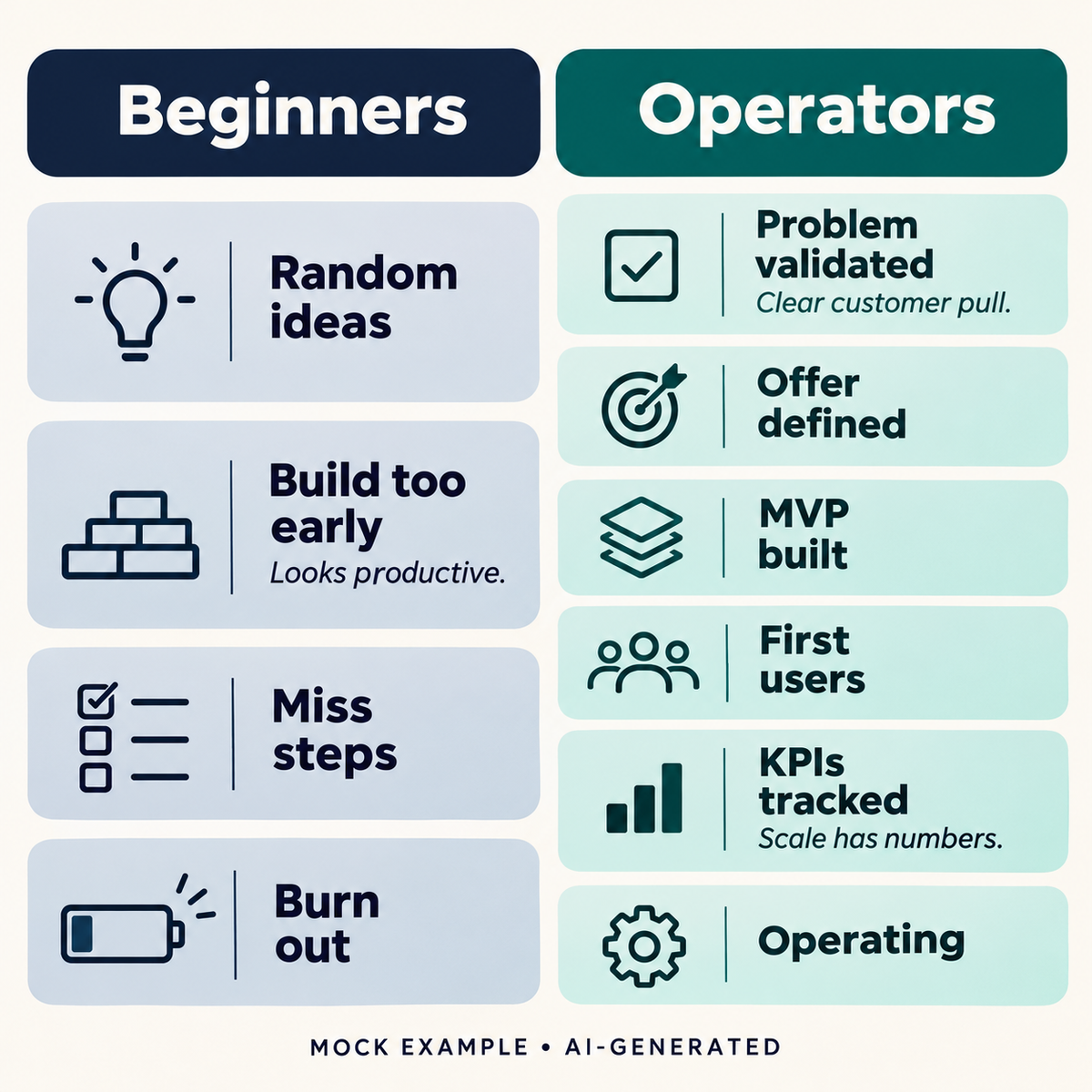
The next graphic divides the world into “Beginners” and “Operators.” Beginners have random ideas, build too early, miss steps, and eventually burn out. Operators follow the right order: validate a problem, define an offer, build an MVP, get users, track KPIs, and operate a system.
There are recognizable ideas in that sequence if you already know the context. That is precisely the problem. Beginners and operators of what? Are we launching software, starting an agency, selling a course, or improving an existing business? The graphic asks a first-time viewer to reconstruct the premise before they can evaluate the advice.
The small subtitles do little to resolve that uncertainty. “Looks productive.” “Clear customer pull.” “Scale has numbers.” They add the appearance of explanation without supplying much of the explanation a new reader needs. Even the acronym MVP presumes a particular vocabulary.
When I work with AI on creative material, this is one of the errors I have to watch for most carefully. The conversation may contain pages of context. I know which business we are discussing, who the customer is, and what problem we are trying to solve. The resulting graphic can quietly assume all of that background while showing none of it.
A person scrolling past does not have my chat history.
The second pass has to begin from their position. What can they understand from this image alone? What category does the advice apply to? What do the labels mean? Why should they care about the difference between the two columns?
A comparison can make a complicated process easier to understand, but only if the viewer knows what is being compared. A diagram full of confident labels cannot compensate for a missing premise.
The book that closes the deal before the call begins? Where do I sign?
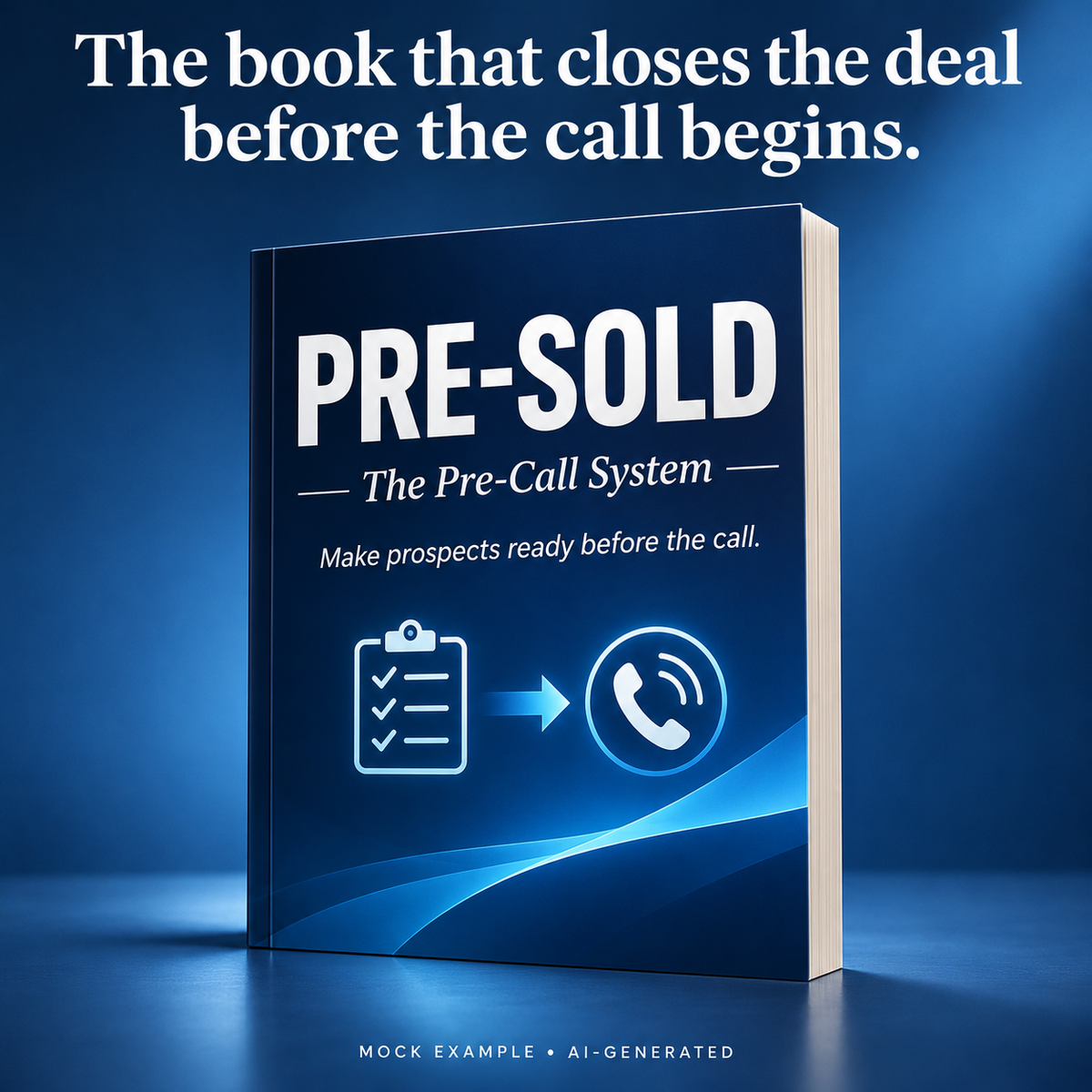
Another ad shows a book called “Pre-Sold,” subtitled “The Pre-Call System,” though I don’t think this was the intended effect. Its headline reads, “The book that closes the deal before the call begins.” The smaller text on the cover says, “Make prospects ready before the call.”
I can make a charitable guess at what is being sold. Perhaps the book teaches a set of tactics for preparing prospects before a sales conversation. Perhaps it explains how to communicate value, answer questions, or qualify a lead before getting on the phone.
Those are intelligible things a book could teach, but the sentence in the ad muddles them. The book is presented as the thing doing the closing, while the cover refers to a system that makes prospects ready. Who reads the book? Who follows the system? What changes before the call? The mechanism has disappeared into the promise.
The issue I am pointing to comes before we even argue about whether the claim is too ambitious. As written, the idea is confused. We are being asked to accept the sentence because we recognize the surrounding sales language, then mentally repair it into something that could make sense.
Figurative language does not need to be painfully literal. I am not proposing that every headline carry its own instruction manual. But there should be a clear relationship between the compressed version and the idea being compressed. If the intended claim is that the book teaches a pre-call process, say that. Then explain what the process helps a business do.
The reader has enough work to do deciding whether they want your product.
Ad copy is the new targeting and dogs are the new cats. Red is the new blue. And so on.
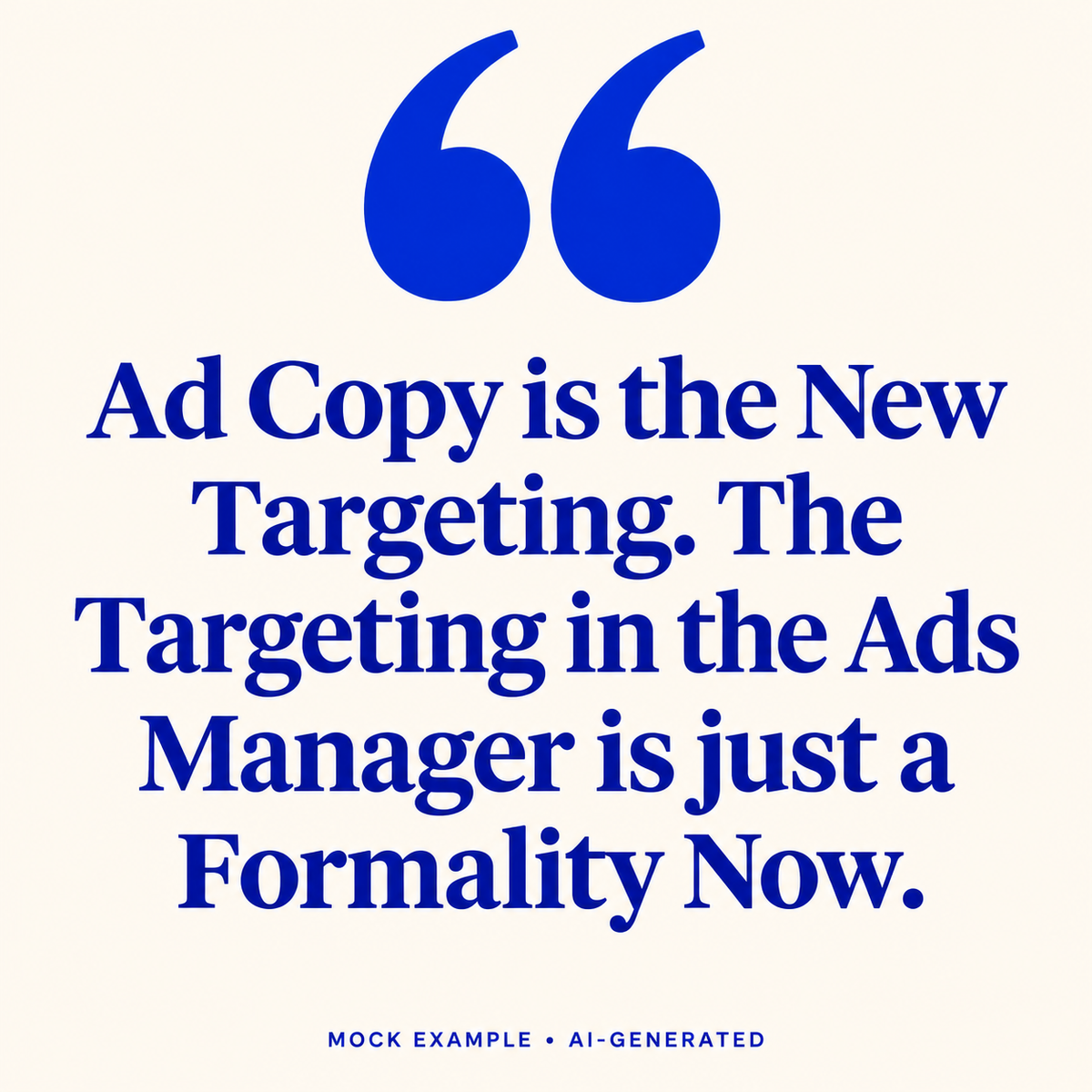
“Ad Copy is the New Targeting. The Targeting in the Ads Manager is just a Formality Now.”
The quotation marks are enormous within the graphic, though the quotation has no attribution. There is an account name above it in the original post, but the image itself offers no reason to treat the statement as authoritative. Even a named speaker would still owe the reader an explanation.
There is a real development behind the cliché. Meta uses machine learning to match ads with people, and the creative you provide is part of what its systems work with. Meta’s own [technical explanation of Andromeda](https://engineering.fb.com/2024/12/02/production-engineering/meta-andromeda-advantage-automation-next-gen-personalized-ads-retrieval-engine/) describes a personalized retrieval system learning relationships between people and ads. That is more complicated than a line of copy replacing audience selection.
The practical point I would make to an advertiser is to think about the creative as a whole. The imagery or video, the offer, the headline, and the copy all contribute to what you communicate and who is likely to respond. Reducing that to “ad copy” leaves out much of the work.
And calling targeting a formality encourages the wrong behavior. Advertisers still need to understand the audience setup they are using. Some inputs may guide automated delivery; other settings can constrain it, a distinction explained in [Jon Loomer’s walkthrough of Advantage+ audiences](https://www.jonloomer.com/how-advantage-plus-audience-works/). Those distinctions depend on the campaign and the options available. You need to know which is which rather than assume every field is either a hard wall or meaningless decoration.
The useful lesson is about the relationship between creative, audience inputs, and automated delivery. The catchy version turns that relationship into a replacement: this is the new that, so you can stop caring about that.
That is a much simpler thing to say. It is also a much less useful thing to tell someone who is about to spend money.
Great news! They just opened a huge culture factory downtown.
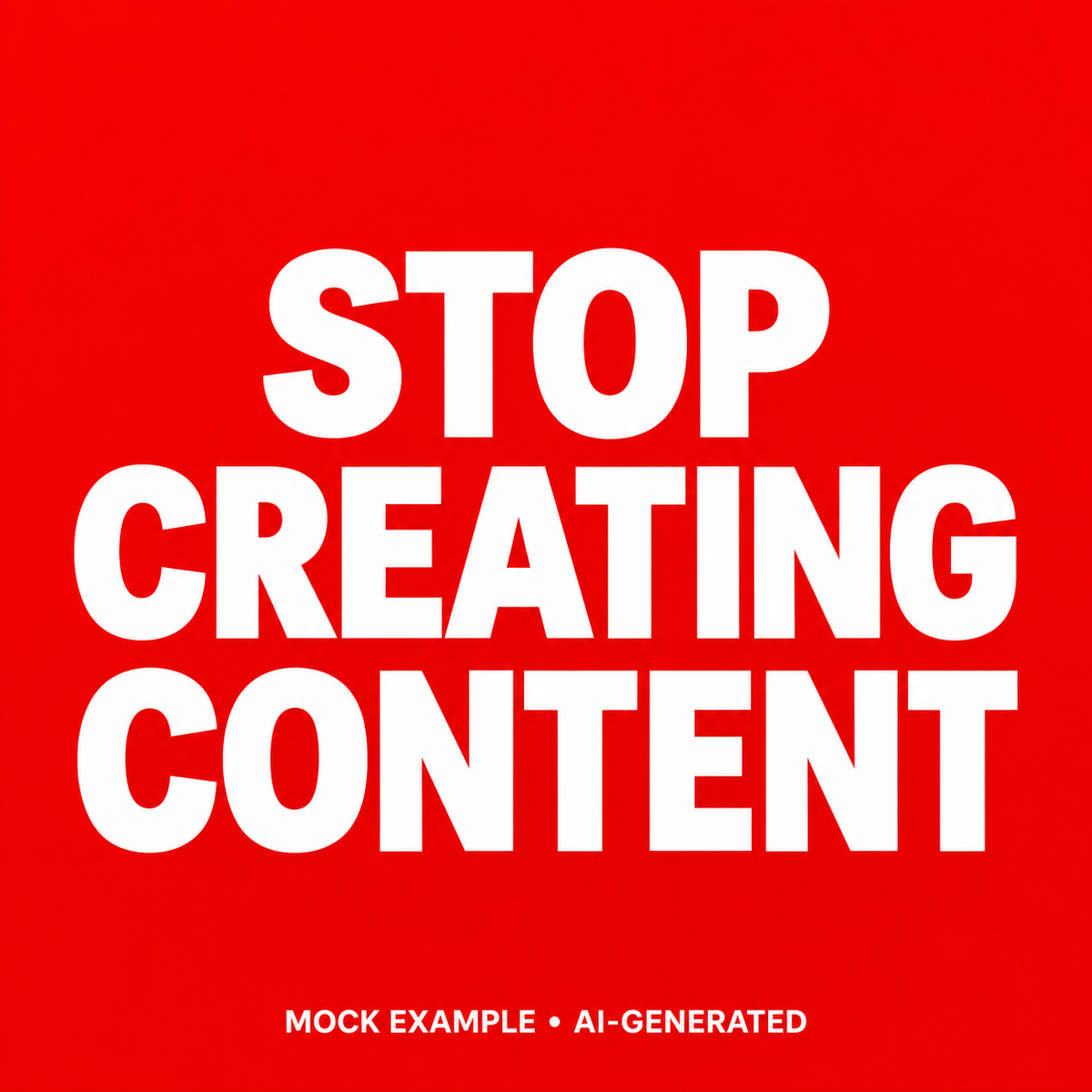
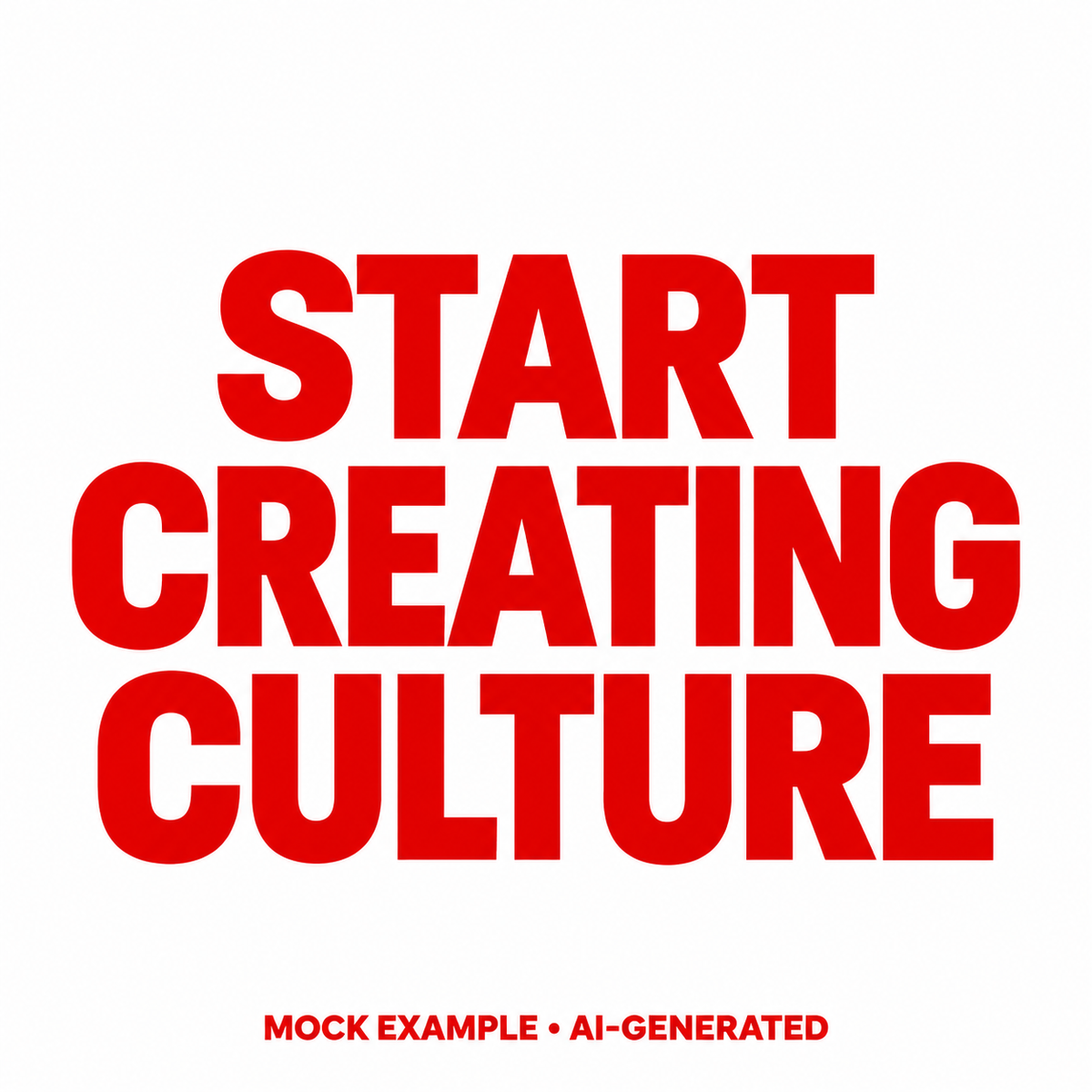
This is almost a perfect specimen of the classic “it’s not x, it’s y” formula. One slide says, “Stop creating content.” The next says, “Start creating culture.”
It feels like a correction. It feels like an insightful new direction. It has the tone of somebody interrupting a room full of people who have all been missing the point. I understand why it gets attention.
But what changes when the reader sits down to work tomorrow?
A business might want its content to participate in an existing community, reflect shared experiences, or give people something they want to repeat and make their own. Those are interesting aims. They would also still involve making content. The second instruction does not actually eliminate the activity prohibited by the first.
“Culture” does a lot of flattering work here. It is a larger, more impressive word than “content,” but without an explanation it gives the business owner very little to act on. What culture? Whose? Through what behavior? What would the business make differently, and how would it know the change was useful?
Presumably, we’re meant to say “Yeah, that’s a great idea! … How do I do that? I should call these guys!”
There may be a developed argument elsewhere. I am looking at the two slides in front of me. As a standalone piece of advice, this misses the mark. As an ad, I couldn’t say without seeing their numbers, but as someone working in the industry, this rubs me the wrong way and stinks of mile-wide, inch-deep copywriting.
This is why I keep returning to the necessity of the second pass. If an AI suggested this line, I would want the next conversation to be about what it actually means. Give me an example. Show me a choice that follows from it. Explain why those two activities are being placed in opposition. If the explanation works, build the content around that explanation instead of publishing only the impressive-sounding conclusion.
Simply meet people before you meet them
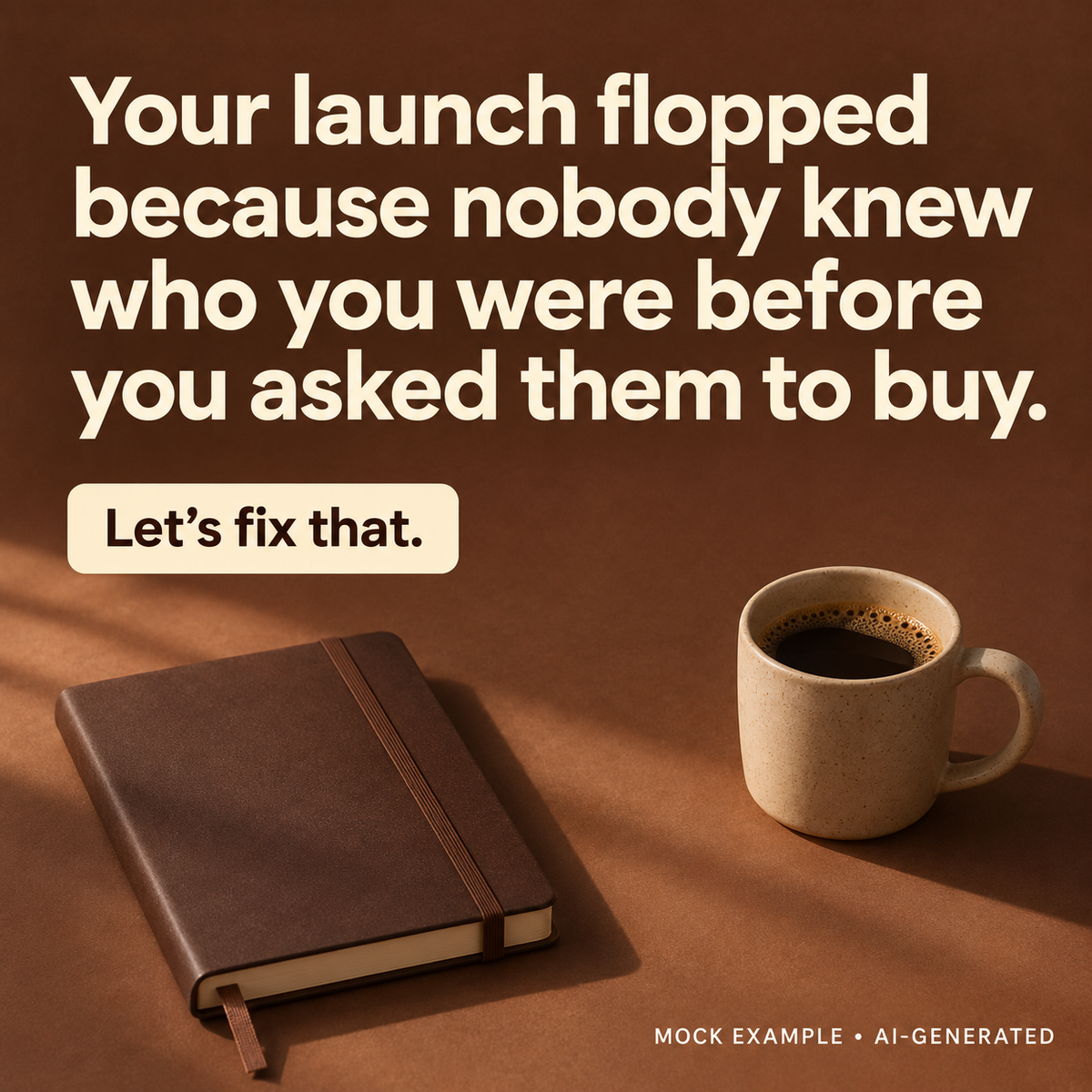
The last image says, “Your launch flopped because nobody knew who you were before you asked them to buy.”
Possibly. But there’s nuance there.
Lack of familiarity can matter when someone is choosing whether to buy or not. But the immediate next question is, okay, so then what’s the alternative? The answer almost certainly being implied here is brand marketing.
This implication bothers me: first make people know who you are, then ask them to buy. For some luxury products and legacy brands, a long period of familiarity and trust is important. For most others, someone can encounter a business for the first time, understand the offer, and buy all at the same time.
Direct-response marketing would not exist if such a thing were not possible.
In my own approach, brand building and asking for a sale can happen together. A piece of content can communicate the personality or quality of a business while giving someone a concrete reason to visit, inquire, or purchase. You can build familiarity with the people who are not ready yet while making it easy for the people who are ready to act.
And you can do that without spending a lot of time and money putting out large quantities of “branded content” with no sales info attached.
I would rather help a business investigate that than convince it that an entire category of work must be completed before it is allowed to sell anything.
The second pass is where you take responsibility
I’m not feigning ignorance here. I know the point of many of these ads is to filter out those that know better; the “Nigerian Prince” email scam still exists for the same reason: you don’t want to waste time talking to people who already know the game you’re playing. Call me an idealist, but I just have higher hopes for our humble (hold for laughter) industry.
The common problem here is easy to miss but important. We recognize a funnel, a quote, a before-and-after comparison, a contrarian headline. The format signals some deeper meaning, some insightful or clever solution, but no useful information has actually been conveyed.
LLMs make it exceptionally easy to produce the appearance of insight. They can help you organize a thought, find a phrase, build a first version of a graphic, or explore ten ways of communicating the same idea. I use them. I expect to keep using them. But the true value of their output comes from taste.
When an AI hands you a piece of marketing, take it out of the conversation that produced it and read it as though you have never heard of these ideas before. Then slow down enough to check a few things.
First, make sure claims are stated in ordinary language. If you cannot explain the headline without repeating the headline, keep working. An interesting choice of words should lead to an intelligible idea.
Second, inspect the comparison or metaphor. What does each part represent? Does the visual preserve that relationship? If two supposedly opposing activities actually depend on each other, explain the relationship rather than pretending one makes the other obsolete.
Third, look for missing context. Your audience did not participate in the brainstorming session. They do not automatically know the industry, process, acronym, or problem that made the draft seem obvious to you. Supply the minimum context they need without making them solve a puzzle first.
Fourth, ask whether the advice survives contact with a real business. What would somebody actually do after reading it? Under what circumstances would that help? Could they reasonably interpret it in a way that leads them in the wrong direction? A slogan can leave out details, but it should not quietly reverse the advice you meant to give.
Finally, read it in your own voice. Would you say this to a customer? Could you defend it if they asked why? Does it express something you have noticed, learned, tested, or genuinely believe, or are you just using it because it sounds catchy?
AI can make an uncertain thought sound complete. It can also make a specific person sound like the average of a thousand marketing posts. Your own observations, qualifications, and examples often make everything punchier.
Keep those things. They are often the reason somebody listens in the first place.
——
Until next time, stay fresh.
Casey